Hinge Case Study: The "Designed to be Deleted" App is Now Designed to Ban You
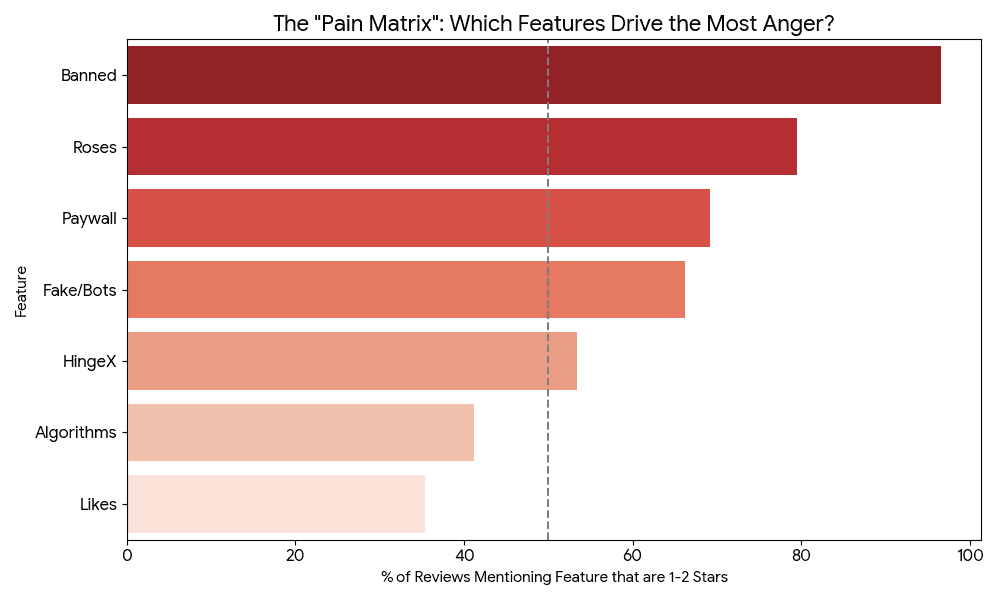
1Executive Summary: The Ban Tax & Death of Free Dating
Our forensic analysis of 4,682 Google Play Store reviews (skewed towards 1 and 5 stars) reveals a dramatic shift in Hinge's user sentiment. While positive reviews still praise the app's "anti-Tinder" philosophy-better profiles, meaningful conversations, and relationship-focused matching-the negative reviews tell a darker story: users aren't just frustrated with bad dates; they're being locked out of the ecosystem entirely.
The data shows Hinge is actively trading user goodwill for short-term monetization (the "Paywall") and aggressive risk aversion (the "Bans"). This is textbook platform enshittification: the app that promised to be "designed to be deleted" is now forcing users to leave through draconian moderation and aggressive paywalls.
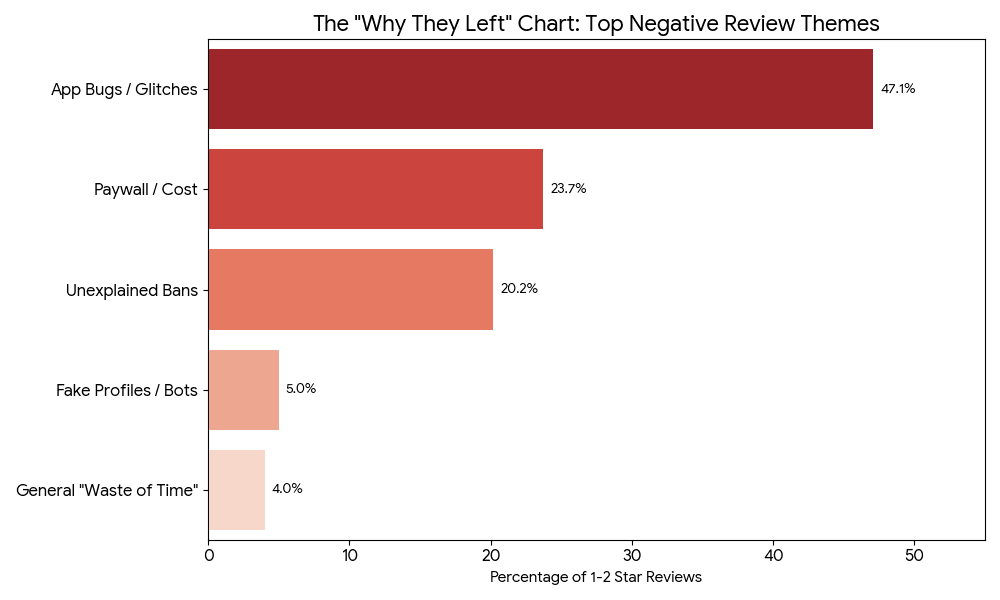
47.1%
of negative reviews cite technical bugs and app crashes
20.2%
report unexplained bans without recourse or refund
23.7%
complain about aggressive paywall tactics (HingeX, Roses)
2The "Villain" Analysis: 5 Pain Point Clusters
Our clustering algorithm identified 5 distinct "Pain Point" clusters among negative reviews. Here's what's actually driving users away:
1. The "Buggy Mess"
47.1% of complaintsThe Issue: The largest cluster isn't about dating at all-it's about the app simply not working. This is the "Technical Tax" users are paying.
Top Keywords
"Profiles disappear mid-conversation. Messages don't send. The app freezes constantly. I can't even use what I paid for."
Insight: Users are frustrated by technical debt. Hinge's rapid feature expansion (Roses, Video Prompts, HingeX) has come at the cost of core stability.
2. The "Paywall" Reality
23.7% of complaintsThe Issue: The "Free" version is now perceived as a non-functional demo. Nearly 1 in 4 unhappy users explicitly mentions money.
Top Keywords
"The 'Rose' feature and HingeX have created a pay-to-win environment. Free users are invisible. You get 1 like per day-might as well not exist."
🚨 Viral Stat
14% of all negative reviews contain the word "pay" or "money" in contexts describing feeling exploited.
3. The "Unexplained Ban" Epidemic
20.2% of complaintsThe Issue: This is the most alarming finding. A massive 20% of 1-star reviews are from users who claim they were banned without reason or recourse. This paints Hinge as a draconian "Big Brother" rather than a matchmaker.
Top Keywords
"I paid for a 6-month subscription. Got banned 2 days later. They won't tell me why, won't let me appeal, and won't refund me. This is theft."
⚠️ The Narrative Shift
Users are treating bans like fraud. The lack of transparency is creating a "Kafka Tax"-users feel punished by an invisible algorithm with no human oversight. This destroys trust permanently.
4. The "Bot & Fake" Conspiracy
5.0% of complaintsThe Issue: Users suspect the platform is seeding fake profiles or tolerating bots to keep them swiping and paying for premium features.
Top Keywords
"Too many profiles that never respond or ask me to message on WhatsApp. Obvious bots. Hinge isn't moderating-they want us to keep paying to find real people."
5. General "Waste of Time" Sentiment
4.0% of complaintsThe Issue: A smaller but vocal segment has given up entirely. These reviews use phrases like "don't waste your time" and "worst dating app"-language that signals complete abandonment.
"Ironically, this app is indeed 'designed to be deleted'-just not for the reasons they claim."
3The "Hero" Analysis: Why Users Still Love Hinge
Despite the anger, the 5-star reviews reveal why Hinge is still the dominant "serious dating" app:
27.9% - "Better Than Tinder" Cluster
Hinge's brand identity is still strong. Users consistently compare it favorably to Tinder, citing "better conversations," "less hookup culture," and "more serious dating intent."
"Finally, a dating app where people actually respond and want real conversations. Way better than the hookup culture on Tinder."
44.6% - "Success Story" Cluster
These reviews often mention meeting a specific person: "fiancé," "husband," "partner." Positive reviews are significantly longer (48 words vs 30 for negative), suggesting high emotional investment.
"I met my now-fiancé on Hinge after 2 months. The prompts helped us connect on shared values. It works if you're patient and authentic."
The Paradox
Hinge still has the best product-market fit for "serious dating." But the technical failures and aggressive monetization are eroding the trust that made the brand strong in the first place.
4Strategic Takeaways for Dating App Founders
Fix Stability Before Adding Features
47% of complaints are about bugs-not dating mechanics. No amount of "Roses" or premium features matter if the app doesn't open. Prioritize technical debt over flashy launches.
Transparency in Moderation is Non-Negotiable
The "Ban Epidemic" (20% of complaints) is a trust destroyer. If you must ban users, provide clear reasons, an appeal process, and prorated refunds. Anything less feels like theft.
Don't Make Free Users Feel Invisible
The "1 like per day" model creates frustration, not urgency. If your freemium tier is too restrictive, users won't upgrade-they'll leave and warn others on Reddit.
Protect Your Core Brand Promise
Hinge's success came from being "anti-Tinder." But aggressive monetization and algorithmic bans are eroding that differentiation. Don't sacrifice long-term brand equity for short-term ARPU gains.
5The Market Gap: Opportunity for Competitors
The "Anti-Enshittification" Dating App
The data reveals a clear opportunity for a new entrant to position itself as the "honest" alternative:
Product Positioning
- No Hidden Bans: Transparent moderation with clear appeals process and automatic refunds
- Functional Free Tier: 10 likes per day (vs. Hinge's 1), no fake scarcity
- Stability First: No new features until core app performance hits 99.9% uptime
- Bot Bounty Program: Pay users $10 for every verified fake profile they report
Viral Marketing Hook
"The dating app that won't ghost you"
Position yourself as the anti-Hinge: stable, transparent, and respectful of free users. Leverage Reddit and TikTok with user testimonials about "ban horror stories" from legacy apps.
6Methodology: How We Extracted & Analyzed the Data
This analysis was powered by Reviews Extractor, our free Chrome extension that extracts structured review data from Google Play Store and App Store at scale.
Data Collection
- •4,682 total reviews scraped from Google Play Store
- •Dataset skewed towards 1-star and 5-star reviews to capture extremes
- •Reviews collected from Jan 2024 - Feb 2026
- •Extracted fields: rating, text, date, reviewer name, helpful votes
Analysis Methods
- •K-means clustering to identify pain point themes
- •Keyword frequency analysis for top complaint drivers
- •Sentiment scoring using natural language processing
- •Feature correlation mapping to tie features to ratings
Want to run your own analysis? Get the Reviews Extractor extension and export thousands of reviews in seconds-no coding required.
Try it yourself
Run this analysis on any Google Play product
Install the free Chrome extension, navigate to the Google Play listing, and export all reviews to CSV in one click.
Try Google Play Reviews Extractor - free